The Founderwright method
CUD.V: Four measures run every company we build. Three are science. One is judgment.
Capacity, utilization, discipline, and value. We reduce a company to these four, measure the first three against its own systems every week, and build the reports and team actions that move them. Value we judge with the owner.
The four measures
What each letter measures, and what moves it.
Capacity
What can the company produce?
The people, equipment, space, hours, and cash the business can put to work. Capacity sets the ceiling. It is the easiest measure to add to and the most expensive to get wrong.
Measured by
- Headcount and paid hours by role
- Equipment, vehicles, and machine hours
- Seats, rooms, bays, or square feet
- Cash and credit available to fund the work
Moved by
- Hiring, training, and retention
- Buying, retiring, or sharing assets
- Shift and schedule design
- Working capital and credit lines
Utilization
How much of it becomes paid work?
The share of capacity that turns into billed, collected revenue. An idle truck, an empty seat, and a technician waiting on parts are capacity the company pays for and doesn’t sell.
Measured by
- Billable hours as a share of paid hours
- Occupancy, fill rate, or uptime
- Booked work against available capacity
- Revenue per unit of capacity
Moved by
- Pipeline and pricing
- Scheduling, dispatch, and routing
- Cutting idle and non-billable time
- Matching capacity to demand by day and season
Discipline
How consistently is the work done?
How reliably the work is done, billed, collected, and closed the same way every time. Discipline is a measure of process, not personality: a checklist either happened or it didn’t.
Measured by
- Work invoiced the day it is finished
- Timesheets and approvals on time
- Days sales outstanding
- Rework, callbacks, and first-pass yield
- A monthly close finished on schedule
Moved by
- Checklists and standard work
- Approvals with named owners
- Agents that flag a miss the day it happens
- A weekly operating cadence
.Value
What is it all worth?
What the work is worth to customers, employees, and owners. The period is deliberate. We report the signals: margin, price, retention, reviews, earnings. The value of a company is still a judgment, made by a customer who comes back, an employee who stays, and a buyer who names a price.
Signals we report
- Margin and price realization
- Customer retention and reviews
- Employee retention
- Earnings and cash flow
- What a lender or buyer would pay
Judged in
- A monthly review with the owner
- Pricing and customer decisions
- Where the next dollar of capacity goes
Why four
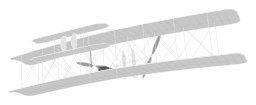
The Wrights broke flight into three problems. Then they flew.
In 1901, Wilbur Wright told a room of engineers in Chicago that flight came down to three problems: wings to carry the machine, power to drive it, and a way to balance and steer it in the air. Two, he said, were already partly solved. Control was the one that mattered.
A company breaks down the same way. Capacity is the lift. Utilization is the power. Discipline is the control. When growth stalls, most owners add capacity: another hire, another truck, another location. Often the gap is utilization or discipline.
Value is the flight itself. The instruments tell you a great deal. Whether the trip was worth making is still a judgment.
Source: Wilbur Wright, “Some Aeronautical Experiments,” Western Society of Engineers, Chicago, September 18, 1901
- LiftCapacityWhat the company can carry: people, equipment, space, and cash.
- PowerUtilizationWhat drives it forward: capacity turned into paid work.
- ControlDisciplineWhat keeps it level: the same process, every job, every month.
- The flight.ValueWorth the trip to customers, employees, and owners. Judged, not measured.
Across industries
Different businesses. The same four measures.
The metrics change names from one industry to the next. The questions don’t.
| Industry | Capacity | Utilization | Discipline | Value |
|---|---|---|---|---|
| Field service | Technician hours, trucks | Billable ÷ paid hours | Same-day invoicing, first-time fix | Margin per tech-hour, agreement renewals |
| Staffing | Recruiters, open orders, payroll funding | Fill rate, hours billed | Timesheets approved on time, DSO | Bill-pay spread, client retention |
| Hospitality | Seats, rooms, labor hours | Occupancy, table turns | Opening and closing checklists, food cost vs. theoretical | RevPAR, average check, guest reviews |
| Manufacturing | Machine hours, operators | Uptime, bottleneck utilization | First-pass yield, on-time delivery | Margin per job |
| Professional services | Professionals, available hours | Billable utilization | Unbilled WIP, lockup days | Realization, effective bill rate |
| Equipment rental | Fleet by class | Time and dollar utilization | Days to invoice, service intervals | Revenue per asset, rate vs. book |
Every industry page maps its own numbers to the four. See all industries.
How it runs
Measure three. Judge one. Repeat.
The method is a cadence, not a report. Each cycle sharpens the next.
Reduce the company to four measures.
In the first conversation, we write down what capacity, utilization, discipline, and value mean for this company, and where each number lives.
Connect the first three to the source.
Capacity, utilization, and discipline report every week from the systems the company already runs, on one set of definitions.
Turn every gap into an owned task.
Agents flag what moved and draft the fix. A named person approves it, and the work is logged.
Review value with the owner.
Each month, the owner and team weigh margin, retention, and price, decide where the next dollar goes, and start the next cycle.
Done steadily, the gains reach everyone the company answers to: steadier work for employees, better service for customers, and a business worth more to its owners.
Where it starts
The CUD.V diagnostic.
Every briefing ends with a one-page map of the company on the four measures.
- Your four measures, defined in your terms.
- Where each number lives today, and whether it can be trusted.
- The largest gap in capacity, utilization, or discipline, in dollars where the data allows.
- Three moves to start with, and what we would build first.
Illustrative data.
Questions
What owners ask about the method.
Is CUD.V only about financial metrics?
No. Capacity, utilization, and discipline are mostly operating measures: hours, seats, uptime, on-time rates, checklists. The financial results show up in value, which is why value is judged across all four.
Why is value set apart by a period?
Because it is more art than science. Capacity, utilization, and discipline can be counted from the systems a company already runs. Value depends on judgment: what customers will pay, whether good people stay, and what a buyer believes about the future. We report the signals and leave the call to the owner.
Does it replace the KPIs we already track?
No. Every KPI you already use sits under one of the four measures. CUD.V is how we organize them, so the command center, the weekly review, and every task point at the same four questions.
Why four measures and not more?
Four is few enough to hold in your head and review every week. Every operating metric we have worked with fits under one of them.
Does it fit companies outside the industries you list?
Any company that turns people, equipment, or space into paid work has the same four measures. The names of the metrics change. The questions don’t.
Start with your four measures.
One conversation about how the company runs. You leave with a CUD.V diagnostic: where capacity, utilization, and discipline stand, and where value is made or lost.
Request a briefing logan@founderwright.com